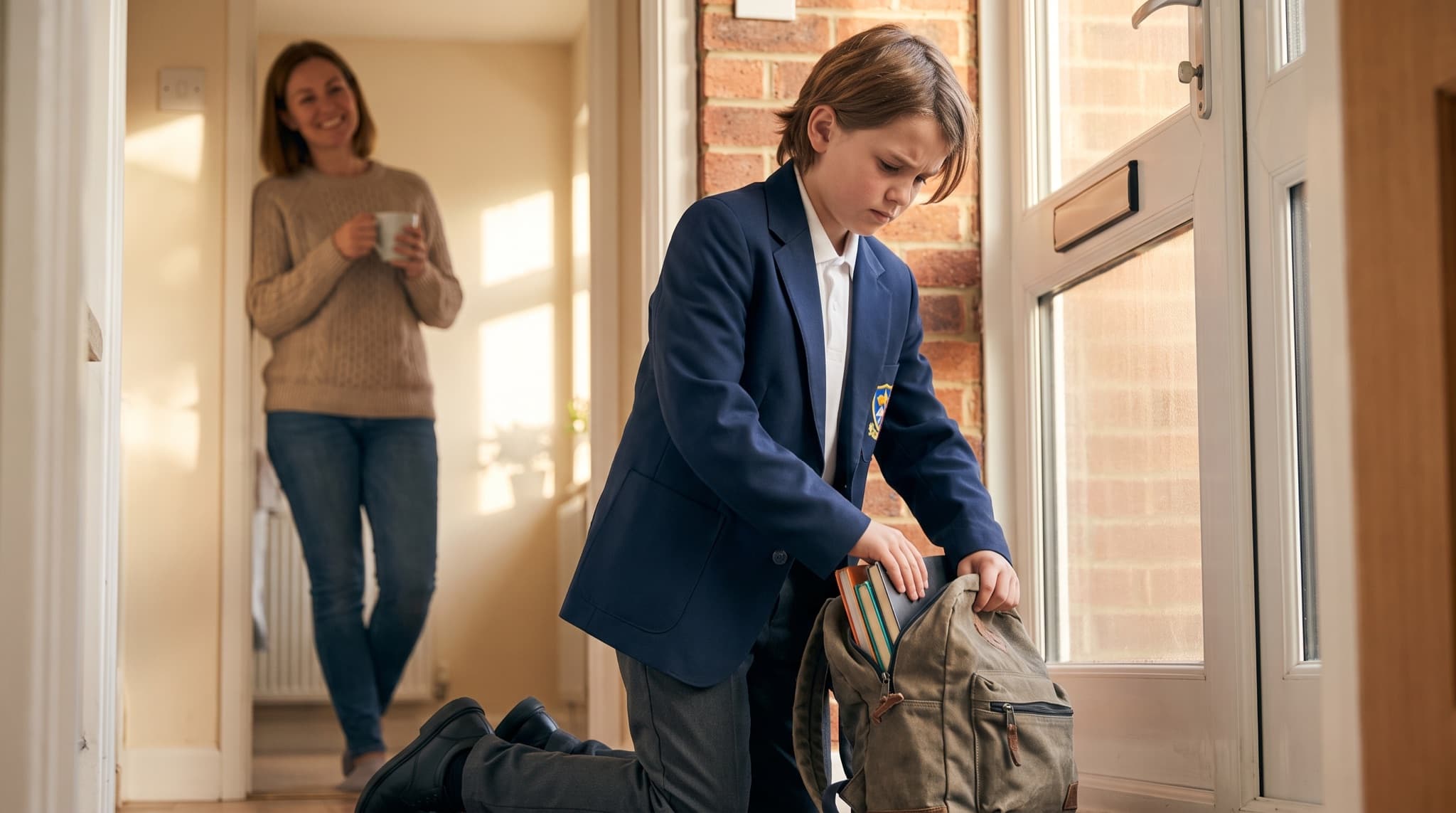
In about a fortnight, your child will walk into a building several times the size of the school they left in July, carrying a timetable they don't understand, to be taught by ten or more adults whose names they don't yet know. If you're feeling more anxious about starting Year 7 than they are, you're in good company — late August is when the year 7 transition stops being an abstract idea and becomes a uniform hanging on the door. This guide covers what genuinely changes when your child moves up to secondary school, what the first term actually looks like week by week, how to tell a normal wobble from a real warning sign, and the small routines that do more than any pep talk.
One thing to hold on to before the detail: the overwhelming majority of children settle. Secondary schools have been inducting nervous eleven-year-olds for a very long time, and they are better at it than most parents expect.
What actually changes when your child moves up to secondary school
The honest answer is: almost everything about the structure of the day, and rather less about the child. It helps to be precise about the differences, because each one explains a behaviour you'll probably see in September.
| Year 6 | Year 7 | |
|---|---|---|
| Teachers | One class teacher who knows everything about your child | Ten or more subject teachers, plus a form tutor who sees them briefly each day |
| Homework | Occasional, usually one subject at a time | Regular, from multiple subjects, with deadlines your child must track themselves |
| Movement | One classroom, one peg, one drawer | A different room most lessons, carrying everything, often across a large site |
| Who notices a problem | The class teacher, usually within days | Nobody automatically — information has to travel between ten adults |
| How ability is judged | Teacher knowledge built over a year | Baseline tests, early assessments and, in many schools, sets |
That last row matters more than parents are usually told, so it gets its own section. But the others explain the classic September symptoms: the exhaustion (miles walked, decisions made, names memorised), the forgotten PE kit (nobody reminds them any more), and the vague answers to "how was your day?" (they genuinely cannot summarise six lessons, four teachers and a fire drill).
Academically, the step-up from KS2 is real but gradual. In maths, Year 7 revisits number, fractions and proportion at greater depth before algebra arrives in earnest; a child with gaps from primary will feel those gaps quickly, because secondary teachers assume the KS2 foundations are in place. In English, the shift is from retrieval to analysis — not "what happened in the story" but "why did the writer choose that word". Neither is a cliff edge, but both reward a secure start.
Setting decisions come earlier than most parents expect
Many secondary schools run CATs (Cognitive Abilities Tests) or their own baseline assessments within the first few weeks of Year 7 — often before the end of September. And many schools use those results, alongside KS2 data and early classwork, to place children into maths sets within the first term. Practice varies enormously: some schools teach mixed-ability all year, some set from week three, most sit somewhere between. It is entirely reasonable to ask your school directly: when do you set for maths, and what information do you use?
The first term counts more than it looks
Many schools inform their first maths setting decisions using tests taken in the opening weeks of Year 7. Sets can be changed later — but it is easier to start in the right one than to argue up from the wrong one.
Two things follow from this. First, don't let a child sit the first weeks of Year 7 carrying known gaps from primary — a disappointing SATs result, a shaky grasp of fractions, times tables that never quite stuck — on the theory that "they'll pick it up". Early assessments will measure the gap before anyone has taught to it. Second, don't panic if the first set placement disappoints. Sets move, particularly in Year 7, and a term of solid work is the most reliable way to move them. What compounds isn't the set label; it's the gap underneath it. That is the same arithmetic that, years later, separates a grade 4 from a grade 7 at GCSE — gaps are far cheaper to close in Year 7 than in Year 11.
A realistic first-term timeline
September: finding feet
Expect tiredness, mislaid equipment, and at least one minor crisis about friends, buses or lunch queues. Most schools deliberately keep the first fortnight gentle — induction activities, tours, form-time games. CATs or baseline tests are common in weeks two to four; they need no revision and shouldn't be revised for, but it's worth your child knowing they exist so the first formal test of secondary school isn't a shock. Homework starts light and ramps up.
October: the first signals
By October you'll get the first real information: many schools send a short settling-in report or hold an early parents' or tutors' evening before half term. Read these for direction of travel, not verdicts. Half term itself — around six weeks in — is the natural first checkpoint: is your child broadly finding their way, even if imperfectly?
November to December: the first real assessments
After half term comes the first proper assessment cycle in most schools, and with it the first data report home — and, where schools set, the confirmation or adjustment of sets. This is when a September wobble either fades into anecdote or starts showing up in numbers. It is also, not coincidentally, the most sensible window to have acted before if you knew there were gaps.
The normal dip versus the warning signs
Almost every child dips in the first half term. Performance often drops slightly from Year 6 — new teachers, new expectations, new marking. Tears, tiredness and "I hate it" on a bad Tuesday are all within normal range.
A wobbly first month is normal
Nearly every Year 7 gets lost, forgets kit, misjudges a friendship and comes home shattered in September. On its own, none of that predicts anything about how the year will go.
What deserves attention is persistence and pattern. Treat these as signals to act, not to panic:
- Still lost at half term. By late October, most children have a routine, a friendship foothold and a working knowledge of the timetable. A child who is still isolated or bewildered needs the form tutor's attention.
- School refusal. Occasional reluctance is normal; escalating physical symptoms on school mornings, or outright refusal, is not something to wait out. Contact the school early — form tutor first, then head of year.
- Maths confidence collapsing. Watch the language. "That test was hard" is a Tuesday. "I'm just bad at maths" repeated for weeks is an identity forming — and it forms fast in Year 7, precisely when sets and early assessments make children compare themselves to each other.
- Homework taking hours, in tears. Year 7 homework should be demanding, not devastating. Regular meltdowns usually mean a knowledge gap, not laziness.
The route for a Year 7 struggling with any of this runs through the form tutor — they are the hub through which all ten teachers' impressions pass. Email them with specifics ("she's spending 90 minutes on maths homework set for 30") rather than generalities, and you'll get a far more useful reply.
Worried about the maths step-up?
Tell us what your child needs and we'll match them with a specialist tutor within 24 hours — and meet-the-tutor sessions are completely free.
Find a tutorRoutines that help a child settle — and cost nothing
The families who find the year 7 transition smoothest tend to have boring, repeatable routines rather than dramatic interventions. Four are worth the effort:
- A homework station. One fixed place — kitchen table is fine — with equipment that lives there, and the phone charging in another room. The point is to remove the nightly negotiation about where, when and whether.
- The planner habit. Five minutes, same time every evening: open the planner (or the school's app), check what's due, pack the bag for tomorrow. Do it with them for the first few weeks, then step back. The goal by Christmas is that they do it without you — organisation is the skill Year 7 actually teaches.
- Sleep, boringly protected. Eleven-year-olds need roughly nine to eleven hours, and secondary school days start earlier and demand more. A consistent bedtime and no phone in the bedroom will do more for concentration than anything you can buy.
- Ten minutes of daily reading. The single easiest academic habit with reach into every subject — comprehension, vocabulary, stamina. Anything they'll actually read counts: novels, football journalism, decent non-fiction. Ten minutes, most days, beats an hour on Sundays.
Where tutoring fits — honestly
Most children starting Year 7 do not need a tutor, and September is usually a month for settling, not adding commitments. But there are three situations where a short, targeted burst of help in the autumn earns its keep:
- Known KS2 gaps. If SATs were disappointing or primary maths never felt secure, six to ten weeks of one-to-one work in the autumn can close specific gaps before they harden into a set placement and before the KS3 curriculum builds on top of them.
- Confidence falling faster than attainment. A child who has decided they're "bad at maths" by October often just needs unhurried one-to-one attention that a teacher with thirty pupils cannot provide. The Education Endowment Foundation has found one-to-one tuition delivers roughly five months' additional progress (small-group around four) — but in Year 7 the confidence effect is frequently what parents notice first.
- Homework that regularly ends in tears. Usually a gap, not a character flaw — and cheaper to fix now than at GCSE.
Practically, online one-to-one fits Year 7 life better than most parents expect: no travel eating into an already exhausting week, easy to slot around new clubs and fixtures, and comparative studies have generally found well-run online one-to-one tuition performs on a par with in-person. It's also cheaper — in-person secondary tuition is commonly advertised at £35–65 an hour plus travel, while online typically runs £15–40. Our online tutoring starts at £18 an hour, pay as you go with no contracts, in a purpose-built online classroom with a shared whiteboard and proper maths tools; every lesson is recorded so your child can rewatch an explanation, and you get your own parent login to see bookings, messages and payments. Tutors are interviewed, qualification-verified and safeguarding-trained, and DBS-checked tutors are marked on their profiles.
For a nervous eleven-year-old, the free meet-the-tutor session matters most: they can say hello, try the classroom and decide whether they like the person before you pay anything — and you can meet as many tutors as it takes. If you do go looking, the questions in our guide to choosing a maths tutor apply just as well in Year 7 as at GCSE — and if you're weighing apps against people, our comparison of AI tutors and human tutors is worth ten minutes. For a wobbling Year 7, the human matters.
Key Takeaways
- A rocky first month is normal
- still lost, refusing school or writing off maths by half term is a signal to act
- Many schools make first maths setting decisions in the autumn term, often informed by tests taken in the opening weeks
- Routines beat heroics — homework station, nightly planner check, protected sleep, ten minutes' daily reading
- The form tutor is your route into the school: email specifics, not generalities
- If KS2 gaps show, a short catch-up burst in the autumn is far cheaper than the same gap at GCSE
What a good first term actually looks like
Not straight top marks, and not a child who loves every minute. By Christmas, a well-settled Year 7 knows where they're going, has a friend or two, does homework without nightly warfare, and talks about at least one subject with something like enthusiasm. Everything else — sets, grades, the rest — has five years to come right, and children who start secure tend to make it come right. Your job this term is smaller than it feels: steady routines, an early word with the form tutor if something persists, and targeted help promptly if maths or English confidence starts to slide. That's it. They settle. They almost always do.
Help your child start Year 7 on the front foot
Lessons from £18 an hour, no contracts, and free meet-the-tutor sessions so a nervous child can say hello before you book anything.
Book a free meet-the-tutor sessionExplore More Tuition Options
lesson Types
Related Articles
Online or in-person tutor? The honest comparison most guides dodge: what each really costs, what the evidence says, and why the deciding factor is usually supply — who you can actually hire from your postcode versus the whole country.
One-to-one tuition is the best-evidenced help you can buy for a struggling student — and the format matters far less than most parents assume. What the research actually says about online tutoring, what it genuinely adds, and where it honestly falls short.
Online tuition typically costs £15–40 an hour; in-person secondary tuition £35–65 plus travel. What actually drives UK tutor prices in 2026, what you get at each band, the red flags that cost parents money, and how to pay less without worse teaching.