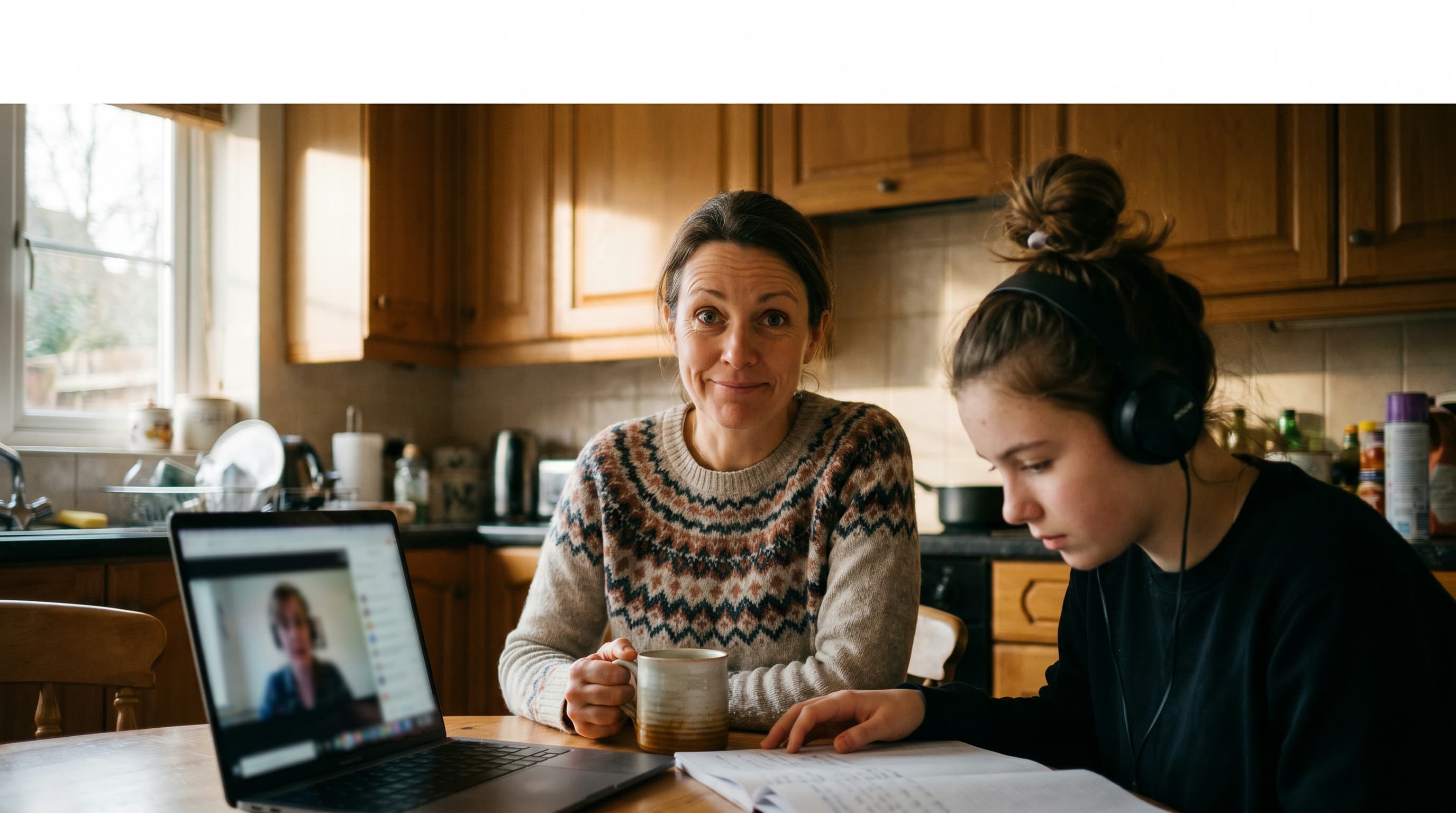
If you are weighing up online vs in-person tutoring this week — GCSE results arrived on Thursday, A-level results the week before, and the autumn term starts in a fortnight — you will find no shortage of confident answers. Agencies with travelling tutors will tell you face-to-face is worth the premium. Online platforms will tell you the screen changes nothing. Both are selling something. The honest version is less tidy: for most children of secondary age, the format matters far less than the tutor — and the biggest real difference between the two options is not price, and it is not personal chemistry. It is supply. It is who you can actually hire.
This guide sets out where online tutoring vs in-person tutoring genuinely differ: what each typically costs once you count the hidden extras, what the evidence says about effectiveness, what a parent can actually see and check in each format — and, because no honest comparison skips it, the situations where in-person still wins.
The difference nobody writes about: who you can actually hire
Before asking whether an online or in-person tutor is better, ask a prior question: who is available to you at all?
If you live in a market town and your child needs an A-level chemistry tutor who knows the OCR specification inside out — not a general science tutor, a specialist — your in-person shortlist is whoever lives within a reasonable drive. Often that is one or two people. Sometimes it is nobody. So you end up choosing not the best tutor for your child but the nearest adequate one, which is a very different thing, and the further you are from a big city the starker the compromise becomes.
Cities have the opposite problem. London, Manchester, Edinburgh and the like have plenty of excellent tutors — and the excellent ones know it. Their evening slots fill by early September, their rates reflect the competition for them, and the tutor you actually wanted is frequently the one who stopped taking new students in July.
Then there is travel, the quiet session-killer. Either the tutor comes to you — and their travel time is folded into what you pay — or you drive your child across town on a wet Tuesday in November after a full school day. It works in September. By February half-term, sessions start slipping, and with tutoring it is consistency, not intensity, that moves grades.
Online tuition dissolves all three constraints at once. A student in Cornwall can work with a further-maths specialist in Newcastle; a family in a Lincolnshire village can pick between several tutors for the exact exam board their school uses. You are choosing from the whole country's specialists rather than a postcode's.
Online tutoring vs in-person tutoring: what each actually costs
Rates vary by subject, level and region, but the commonly advertised ranges are consistent enough to compare honestly. In-person secondary-level tuition is typically advertised at £35–65 an hour, with experienced London tutors often charging more; agency-arranged in-person tuition frequently starts above £50; and 11+ or admissions specialists commonly advertise £40–70 in person. Online tuition typically runs £15–40. Our own tutors charge £18–40 an hour depending on experience and level, pay as you go, with no contracts.
| Online (typical) | In person (typical) | |
|---|---|---|
| Advertised hourly rate, secondary level | £15–40 | £35–65; experienced London tutors often more |
| Agency-arranged tuition | Usually within the standard online range | Often £50+ |
| 11+ and admissions specialists | Usually within the standard online range | £40–70 commonly advertised |
| Travel time and cost | None | Your evening or theirs — and often priced into the rate |
| Choice of tutors | The whole UK | Whoever lives within driving distance |
| Cancelling a session | Straightforward — ours is free up to 24 hours before | Awkward when someone has planned a journey; terms vary widely |
| Record of what was taught | Lessons can be recorded and rewatched — ours all are | None |
The hidden costs of in person
The advertised hourly rate is rarely the whole price. Add travel time, the narrower pool you are choosing from, and the friction of cancelling on someone who has planned a journey to your house, and the true gap with online is wider than the headline rates suggest.
Is online tutoring as good as in person?
The short answer, for most children over about seven: yes, when it is done properly. The Education Endowment Foundation has found that one-to-one tuition delivers roughly five months' additional progress, with small-group tuition delivering roughly four. That finding is about the power of one-to-one attention itself, not the room it happens in — and comparative studies have generally found well-run online one-to-one tuition performs on a par with in-person. We have written a fuller answer to does online tutoring actually work if you want the detail.
The phrase worth pausing on is well-run. A webcam pointed at a textbook on a kitchen table is not proper online tuition. Our lessons happen in a purpose-built online classroom — video, a shared whiteboard both tutor and student write on, dedicated maths tools — so working through a simultaneous equation together feels like sitting at the same desk, not talking at a screen. And because every lesson is recorded, each one doubles as a revision resource: your child can rewatch the quadratics lesson the night before the test. No in-person session, however good, leaves anything behind but memory and a page of notes.
Meet a specialist before September
Tell us what your child needs — we'll call you today, match you with a tutor within 24 hours, and you meet them free before paying anything.
Find my tutorWhat a parent can actually see
Here is an unglamorous difference that deserves a plainer airing than it usually gets. When a tutor comes to your house, or your child goes to theirs, the hour happens behind a closed door. There is no record of what was taught, how the time was used, or how your child was spoken to; your knowledge of the session rests entirely on asking a teenager how it went. That is not a safety warning — the great majority of in-person tutors are dedicated professionals — it is simply a statement about verifiability. You are trusting, because there is nothing to check.
Online, everything leaves a trace. Every lesson on our platform is recorded and can be rewatched, which means you can judge the teaching quality yourself in week one rather than waiting for a results-day verdict. You get your own parent account, with a linked login for your child, so bookings, payments and every message between tutor and student are visible to you. Oversight is built into the format rather than bolted onto it.
Vetting you don't have to do yourself
Every tutor on our platform is interviewed, qualification-verified, and safeguarding and child-protection trained and tested, with an A/A* or a degree in the subject they teach. Tutors who hold a DBS check have it marked clearly on their profile.
Compare that with hiring locally through a noticeboard or word of mouth, where checking qualifications, references and safeguarding training falls entirely to you. Plenty of parents do it diligently. But it is work, and it is easy to skip when a tutor comes warmly recommended by another parent.
When in-person tutoring still wins
An honest comparison has to concede real ground, and there is some.
- Children under about seven. Early readers and very young children generally need physical presence — phonics, handwriting and counting with real objects do not translate well to a screen, and neither does a five-year-old's attention span.
- Some attention and engagement needs. A minority of children, including some with significant attention difficulties, genuinely engage better with an adult in the room. Others, it should be said, focus better online, away from the social pressure of a stranger at the kitchen table. If you are unsure, trial both formats and watch your child rather than the theory.
- No quiet space or unreliable internet. Online tuition needs a door that shuts and a stable connection. If your home cannot offer either, a library-based or in-person arrangement may simply work better.
If your family sits in one of these categories, pay the in-person premium without guilt. The format should serve the child, not the other way round.
Stop choosing a format — choose a tutor
For everyone else, "online or in-person tutor" is the wrong question. The right one is: who is the best tutor my child can work with, at a price we can sustain every week for two terms? A £25-an-hour specialist your child sees weekly all year will beat a £60-an-hour tutor you quietly drop at Christmas. Our guide to choosing a GCSE maths tutor covers the questions worth asking, and most of them apply in any subject — whether the goal is pushing a grade 4 up to a grade 7 or preparing for the November resits.
Because online tutoring lets you choose from every specialist in the country rather than the handful within driving distance, that question has a better answer online for most families — usually at half the commonly advertised in-person rate. And you do not have to choose blind: meet-the-tutor sessions are free, you can meet as many tutors as you like, and you pay nothing until you have found the one whose explanations actually land. By all means talk to the best local in-person option too and compare. The tutor who makes the ideas click is the right answer, wherever they happen to live.
Key Takeaways
- For most children over about seven, the tutor matters far more than the format
- In-person choice is limited to your driving radius — online opens every specialist in the UK
- Commonly advertised in-person rates run £35–65+ an hour before travel
- online typically £15–40
- Recorded lessons and a parent account give you oversight no face-to-face session can
- Under-sevens, some attention needs, or no quiet space at home — in person still wins there
Start with a free meeting, not a payment
Fill in a short form, get a call today, and meet matched specialist tutors free — lessons from £18 an hour, no contracts, cancel free up to 24 hours before.
Book a free meet-the-tutor sessionExplore More Tuition Options
lesson Types
Related Articles
Online tuition typically costs £15–40 an hour; in-person secondary tuition £35–65 plus travel. What actually drives UK tutor prices in 2026, what you get at each band, the red flags that cost parents money, and how to pay less without worse teaching.
One-to-one tuition is the best-evidenced help you can buy for a struggling student — and the format matters far less than most parents assume. What the research actually says about online tutoring, what it genuinely adds, and where it honestly falls short.
Diagnosed, suspected, EHCP or just struggling: what to ask a SEN tutor, which qualifications mean something, and why online one-to-one suits these children.