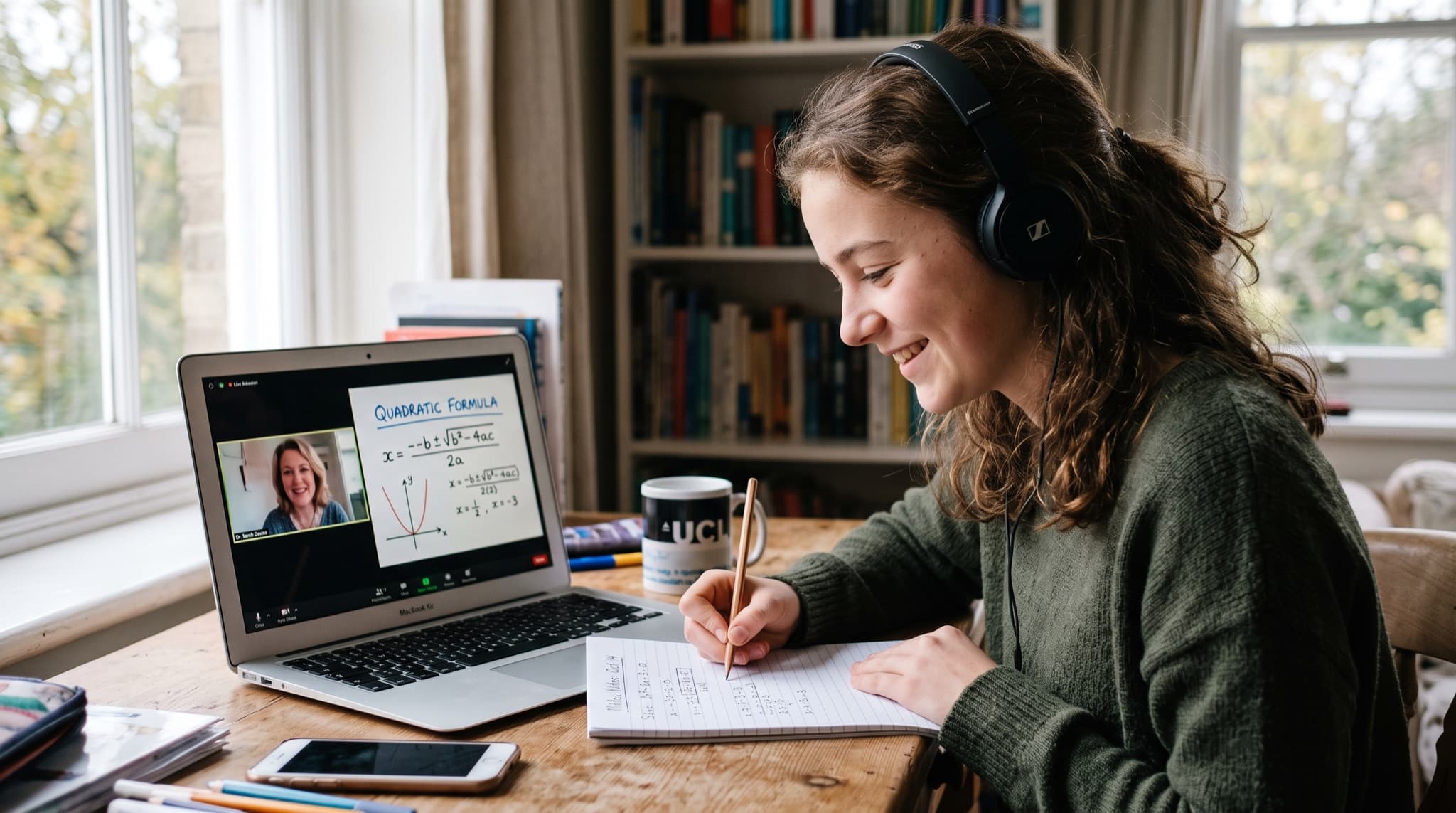
GCSE results arrived on Thursday; A-level results the week before that. If you are now weighing up a tutor before term starts in under a fortnight, the question of whether online tutoring is effective is not a theoretical one — you are about to spend real money, and some of your child's limited time and confidence, on the answer. So here it is up front: one-to-one tutoring is the best-evidenced help you can buy for a struggling student, and the research suggests the format matters far less than most parents assume. What matters is the tutor. The rest of this article sets out the evidence for that — what actually determines whether tutoring works, what online genuinely adds, and where, honestly, it falls short.
Does tutoring work at all? Start with the evidence
Before asking whether online tutoring works, it is worth being clear that tutoring itself works — unusually well. The Education Endowment Foundation, which grades education interventions by the strength of their evidence, has consistently found that one-to-one tuition delivers roughly five months of additional progress over a year, with small-group tuition close behind at roughly four. Very few things in education carry evidence that strong, and almost none of them are things a parent can simply go out and arrange on a Tuesday evening.
The reasons are not mysterious. In a class of thirty, a teacher cannot stop for one child's misconception; a tutor can stop for nothing else. Questions get asked that would never be asked in front of peers. The pace is set by one student rather than the middle of a room. Feedback arrives in seconds, not in red pen a week later. Everything we know about how children learn says those conditions should work — and the evidence says they do.
What actually determines online tutoring effectiveness
Whether any given arrangement delivers those results depends on a short list of things, and it is worth knowing the list, because format is nowhere near the top of it:
- Tutor subject knowledge. A tutor working at the edge of their own understanding cannot untangle someone else's confusion. Look for an A/A* or a degree in the subject they teach, not just enthusiasm.
- Feedback quality. The difference between a good tutor and an average one is diagnosis: working out why an answer went wrong rather than simply re-explaining the method louder. This, incidentally, is where human tutors still clearly beat AI tools.
- Frequency and consistency. A weekly slot held term after term outperforms intense bursts followed by silence. Moving GCSE maths from a grade 4 to a grade 7 is a months-long project, not a half-term one.
- Alignment to the exact specification. A tutor who knows your child's board and its question styles teaches to the marks that will actually be awarded. Even in English, the boards differ more than most parents expect.
Format sits a long way down that list. Comparative studies have generally found that well-run online one-to-one tuition performs on a par with in-person tuition. That should not be surprising: nothing on the list above requires two people to share a room. A weak tutor is weak on either side of a screen, and a strong one is strong in both.
What online genuinely adds
Every lesson is still there at revision time
An in-person lesson evaporates the moment the tutor leaves. Whatever was explained brilliantly at 5pm on a Wednesday exists afterwards only in your child's notes and memory. Every lesson through our online tutoring is recorded and can be rewatched — so in March, revising the exact circle-theorem explanation that finally made sense in October, your child watches that explanation again rather than a stranger's video covering it differently. By mock season, an autumn of weekly lessons has quietly become a personal revision library.
You choose from the whole country, not your postcode
In-person tutoring means choosing from whoever happens to live within driving distance and have a free evening. Online, the pool is the whole UK — which is how a student in a small town gets a further-maths specialist, or a tutor who has marked for their exact board. We have written a fuller online versus in-person comparison, but this is the single biggest structural advantage: the best-matched tutor for your child almost certainly does not live nearby.
No travel means the sessions actually happen
Consistency is one of the things that makes tutoring work, and travel is what quietly kills it — traffic, dark winter evenings, a tutor juggling journeys between houses. Remove the travel and the weekly slot tends to survive the term intact. Fewer cancellations is not a glamorous advantage, but over a year it may be the most valuable one.
The workings are visible both ways
Good online tuition does not happen over general-purpose video-call software. Lessons run in a purpose-built online classroom with video, a shared whiteboard and proper maths tools, so the tutor watches every step your child writes and the child keeps the model workings in front of them — arguably clearer than peering over a shoulder at a kitchen table. Parents also get their own account, with their child's login linked to it, so bookings, messages, payments and the lesson recordings themselves are all visible to you. That level of transparency is simply hard to replicate when tuition happens behind a closed door in someone else's front room.
See who the right tutor would be — for free
Tell us the subject, level and exam board; you'll get a call the same day and a match within 24 hours, with free meet-the-tutor sessions before you pay a penny.
Find a tutorThe honest limits of online tutoring
None of this means online is right for every child, and it would be dishonest to pretend otherwise.
Very young children usually need a person in the room. Below the age of about seven, attention is held by physical presence and energy far more than by anything on a screen. For that age group, in-person remains the sensible default.
It needs a workable setup. A quiet space, a stable internet connection and a device with a camera are genuine prerequisites. A lesson fought over a patchy connection at the kitchen table during dinner is a lesson wasted, whatever the tutor's quality.
It will not, by itself, re-engage a switched-off teenager. A disengaged fifteen-year-old is disengaged in both formats. What changes engagement is almost always the tutor — the right person asking the right questions — which is precisely why free meet-the-tutor sessions exist: you can meet as many tutors as you like, at no cost, until your child clicks with one.
A screen won't rescue the wrong match
If your child is switched off, changing the format rarely changes that. Change the tutor. The fix for a bad fit is a better fit — not a different room.
How to judge a tutor in a free first meeting
Since the tutor is the variable that matters, the free first meeting is where the real decision gets made. Three things to watch for:
- Do they diagnose before they teach? A good tutor's first instinct is to find out where your child actually is — a few probing questions, a look at a recent paper — not to launch into a prepared lesson. Teaching before diagnosing is guessing.
- Do they ask which exam board? A tutor who asks about the board, the tier and the target grade in the first ten minutes is planning to teach your child's actual course. One who doesn't is planning to teach the subject in general, which is not the same thing.
- Do they explain one thing and check it landed? Ask them to cover one topic your child finds hard, then watch whether they confirm understanding — by having the child do one, not by asking "does that make sense?" (everyone says yes).
Rapport matters too, and your child's verdict on it is data, not politeness. We have a fuller guide on how to choose a GCSE maths tutor, but those three checks travel across every subject.
You don't have to guess
Free meet-the-tutor sessions mean you can meet as many tutors as you like before paying anything. Every tutor is interviewed, qualification-verified and safeguarding-trained, with DBS-checked tutors marked on their profiles.
What it costs — and what you are paying for
Online tuition is also, bluntly, cheaper — not because it is a lesser product, but because nobody is billing you for travel time and a smaller local market is not setting the price.
| Arrangement | Commonly advertised rates |
|---|---|
| In-person secondary tuition (independent tutor) | Typically £35–65/hour, plus travel; experienced London tutors often more |
| In-person via an agency | Often £50+/hour |
| 11+ and admissions specialists, in person | Typically £40–70/hour |
| Online one-to-one | Typically £15–40/hour |
Our tutors charge £18–40 per hour depending on experience and level, pay as you go — no contracts, no packages, and free cancellation up to 24 hours before a lesson. At those rates, the money saved against a typical in-person arrangement funds several extra weeks of tuition a term, and frequency, as above, is one of the things that actually moves grades.
Choose the tutor, not the postcode
The format debate is settled enough. Tutoring works — roughly five months of additional progress for one-to-one is about as strong as evidence in education gets — and well-run online tuition holds its own against in-person while adding recordings, reach and reliability that a living-room lesson cannot. The question worth your energy this week is not online or in-person but this tutor or that one: subject knowledge, diagnosis, consistency, fit.
And if Thursday's results mean a November resit in maths or English, the clock is tighter than it looks — the November 2026 resit dates and deadlines leave roughly ten teaching weeks from the start of term. A consistent weekly slot, started in September with the right person, matters far more than the room it happens in.
Key Takeaways
- One-to-one tuition is the best-evidenced intervention in education — roughly five months' additional progress in a year
- Format barely matters: well-run online one-to-one generally performs on a par with in-person
- What does matter: subject knowledge, feedback quality, weekly consistency and exam-board alignment
- Online adds recorded lessons, the whole UK's tutors, fewer cancelled sessions — at typically half the in-person price
- Use free meet-the-tutor sessions to test the tutor before spending anything
Start with a free meeting, not a payment
Fill in a short form, get a call today, and meet matched tutors free until one clicks — lessons from £18/hour with no contracts.
Book a free meet-the-tutor sessionExplore More Tuition Options
lesson Types
Related Articles
Online or in-person tutor? The honest comparison most guides dodge: what each really costs, what the evidence says, and why the deciding factor is usually supply — who you can actually hire from your postcode versus the whole country.
Online tuition typically costs £15–40 an hour; in-person secondary tuition £35–65 plus travel. What actually drives UK tutor prices in 2026, what you get at each band, the red flags that cost parents money, and how to pay less without worse teaching.
Diagnosed, suspected, EHCP or just struggling: what to ask a SEN tutor, which qualifications mean something, and why online one-to-one suits these children.