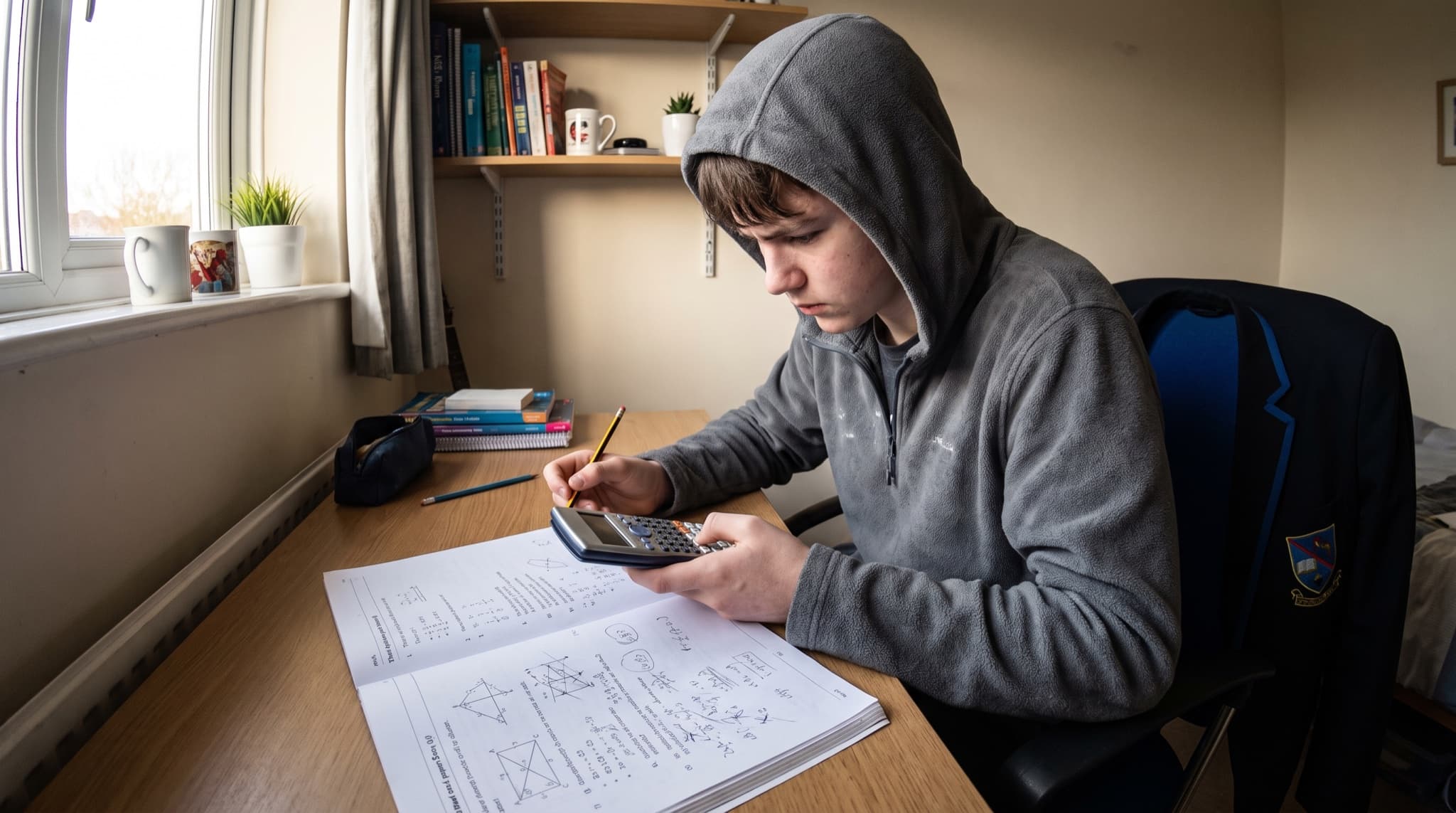
The GCSE Maths Topics That Cost the Most Marks
After working with hundreds of GCSE maths students, clear patterns emerge. The marks that decide a grade rarely disappear evenly across the paper — they cluster around the same handful of topics, year after year, on every exam board. Not because those topics are impossibly hard, but because they're taught quickly, forgotten over summer, and then tested under pressure in unfamiliar wrapping. If revision time is short — or if a November resit is now on the calendar — these six areas are where the recoverable marks live.
1. Ratio and Proportion
Ratio appears on both foundation and higher papers, and examiners' reports flag it every single year. Students handle a bare “share £240 in the ratio 3:5” comfortably — then drop the same marks when the ratio arrives dressed as a recipe, a currency conversion, a best-buy comparison or a map scale. The failure isn't the arithmetic; it's not recognising the question as ratio at all.
The fix: practise identifying the topic before solving it. Take a mixed set of worded questions and, before any working, label what each one really is. Then anchor one reliable method — find the value of one part first — and use it everywhere, every time.
2. Algebra — Specifically Rearranging and Solving
Basic equation solving is usually fine. The marks vanish when a formula has to be rearranged where the subject appears twice, when a minus sign needs carrying through three lines of working, or when factorising is the step nobody spotted. This matters double at GCSE because algebra isn't one question — it leaks into geometry, proportion and problem-solving, so one shaky skill taxes the whole paper.
The fix: slow, written-out working — one operation per line, applied to both sides. It feels pedestrian; it is also how method marks are awarded. A student who shows four honest lines can score three marks with the wrong final answer. A student who does it in their head scores zero the moment anything slips.
3. Probability
Single-event probability is nearly free marks. Combined events are where grades are decided: tree diagrams with a “without replacement” twist, conditional probability, and the difference between adding and multiplying. Students who memorised procedures rather than understanding them multiply when they should add — and the mark scheme gives nothing for a confidently wrong rule.
The fix: always draw the tree, even when the question doesn't ask for one, and write the fractions on the branches before touching the calculator. “And means multiply along the branch, or means add between branches” does more for most students than a week of abstract practice.
4. Bounds and Error Intervals
A short topic that punches far above its weight on higher papers, and one of the most-skipped in revision. Students round when they should truncate, use 5 when the degree of accuracy demands 0.5, and — the classic — pick the wrong combination of upper and lower bounds in a division. These are two-and-three-mark questions that strong students routinely surrender whole.
The fix: one focused afternoon. Bounds is a small, closed topic — fifteen practice questions cover essentially every variant the boards use. For a division, write out both bounds of both numbers and think: biggest answer needs the biggest top and the smallest bottom.
5. Geometry Proofs and Circle Theorems
The circle theorems themselves are learnable in an evening. The marks are lost in the reasons: the mark scheme demands the theorem quoted in accepted wording — “the angle in a semicircle is 90°”, “opposite angles of a cyclic quadrilateral sum to 180°” — and an answer of 47° with no reason often earns less than half the credit. Congruence proofs fail the same way: correct instinct, missing justification.
The fix: learn the theorems as sentences, not pictures, and write a reason for every step even when it feels laboured. In proofs, the words are the answer.
6. Statistics — Histograms and Cumulative Frequency
Histograms are the great false friend of paper 3: they look like bar charts, and treating them as bar charts is precisely the error the question is built to catch. Frequency density, unequal class widths, reading a median from a cumulative frequency curve, comparing box plots with a written comment — each is mechanical once understood, and each is routinely fumbled by students who have only ever skim-read the topic.
The fix: drill the identity frequency = frequency density × class width until it's reflexive, and practise writing one-sentence comparisons that mention both a measure of average and a measure of spread — that exact pairing is what the mark scheme wants.
What to Do About It
Don't revise the whole specification evenly — that's how tired students stay at the same grade. Sit one full past paper untimed, list every dropped mark by topic, and you'll usually find three or four of the six areas above doing most of the damage. That list is the revision plan. A week per topic cluster — taught properly, then drilled with real exam questions against the mark scheme — moves a grade in a way that generic revision never does.
This is also exactly the shape of a November resit campaign. If results day delivered a 3 — or a 4 where a 5 was needed — there are ten teachable weeks between early September and the November papers, and the syllabus is still fresh. One hour a week with a specialist who knows your child's exam board, aimed squarely at the topics on that dropped-marks list, is the highest-percentage move available. Tell us the board and the target grade and we'll match your child with a GCSE maths specialist — online, safeguarding-trained, usually within hours.
Frequently asked questions
Which topics should a foundation-tier student prioritise?
Ratio and proportion, the number work that supports it (percentages, fractions of amounts), and basic algebra. Foundation grades are won on accuracy across many short questions — secure methods beat exotic topics every time.
And for a student chasing a 7, 8 or 9?
Algebraic fluency under pressure, bounds, conditional probability and the proof-style questions — the last third of the higher paper is where those grades are separated, and it leans heavily on the topics above.
How early should resit revision start?
For the November series: the first week of September. Entries go in through the school or college in early October, the exams land in the first half of November, and ten weeks is comfortable — eight is tight. For a summer resit, a steady hour a week from autumn beats any spring cram.
Are these topics the same on AQA, Edexcel and OCR?
The content is set nationally, so yes — all three boards test the same specification. The wording, question style and paper structure differ, which is why practising on your child's board's past papers, with its mark schemes, matters so much in the final weeks.
Explore More Tuition Options
lesson Types
Related Articles
Foundation or higher? A clear guide to help parents and students make the right tier decision for GCSE maths.
A structured revision plan for GCSE Maths covering the key topics, timing, and techniques to maximise your grade — whether you're aiming for a 5 or a 9.
What Bristol parents need to know about tutoring — from the 11+ for Bristol Grammar to GCSE and A-Level support.