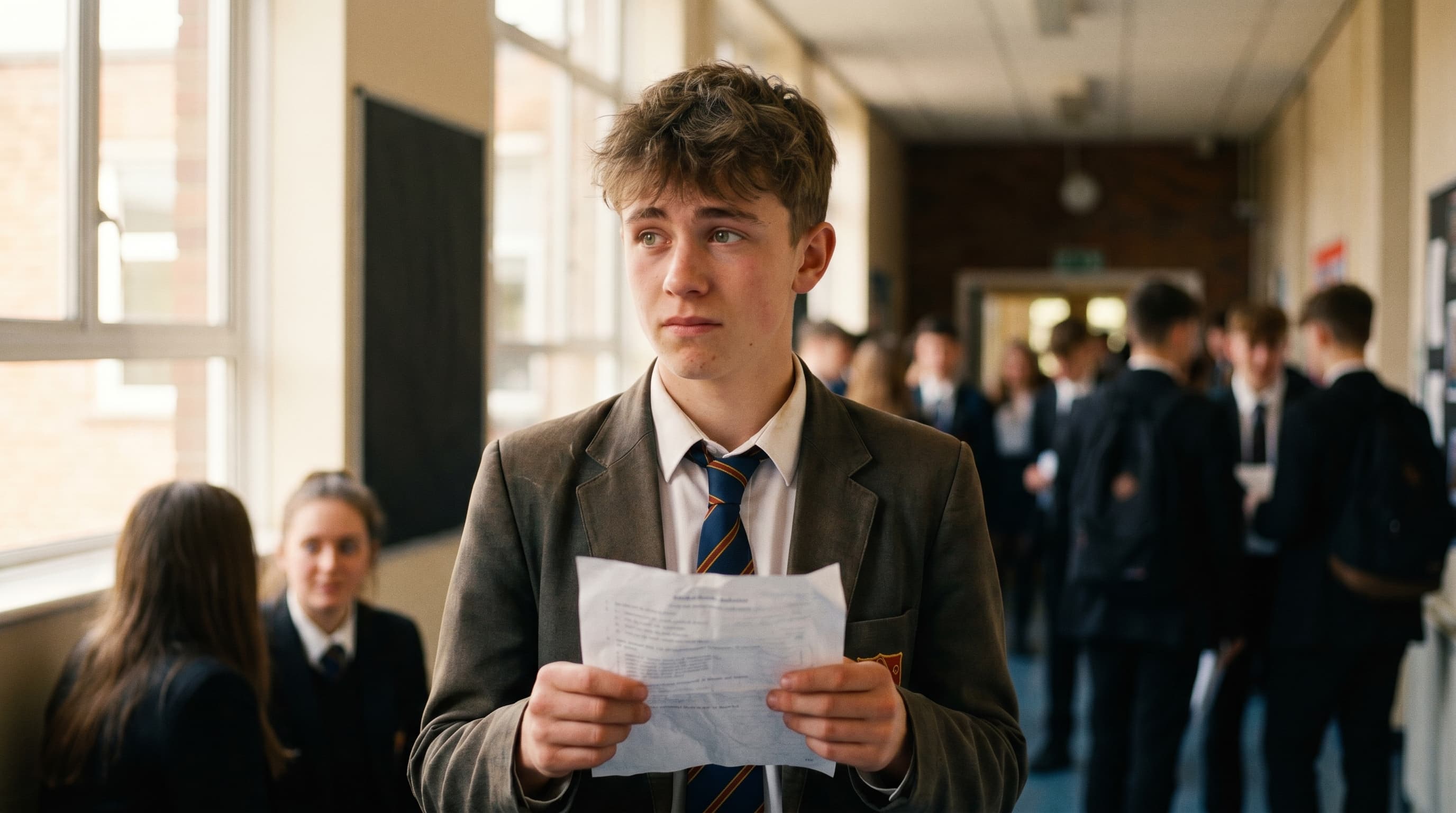
Paper 1 ended at lunchtime. Your son or daughter has just walked through the front door. Whatever they say in the next five minutes is going to shape how Paper 2 goes on Friday — more than any last-minute revision could.
The first sixty minutes matter more than the next six hours of revision
Here is the part most parents get wrong. The instinct is to ask, gently or otherwise, how did it go? The trap is in the answer. A teenager who has just spent ninety minutes in a silent hall under exam conditions does not actually know how it went. They know which questions felt hard. They know whether they finished. They do not know whether they got the marks. And the moment you ask, their brain begins constructing a verdict — usually a pessimistic one, because the brain remembers the questions that hurt, not the ones it answered cleanly.
So the first thing to do tonight is not to debrief Paper 1. It is to protect your child's mood and energy for Paper 2. The single biggest predictor of how a student performs in the calculator paper is how rested, calm and unrattled they feel walking in. Everything else — the topic revision, the practice papers, the formulae drilled three weeks ago — is already locked in.
What not to say
Avoid any sentence beginning with did you get. Avoid what did you put for. Avoid I saw the questions on TikTok, which by tonight will be everywhere. Social media is going to be flooded by midnight with confident-sounding teenagers claiming answers you cannot verify. None of it is useful and almost all of it raises anxiety.
Also, please, do not run the paper through ChatGPT and report back. We've seen parents do this with kind intentions. It nearly always makes things worse, because the model will gladly produce confident answers that are sometimes wrong — and your child will then spend the night second-guessing the question they were actually most certain of.
The job tonight is not to find out how they did. The job is to make sure they walk into Paper 2 in the same shape they walked into Paper 1.
The five-minute conversation that actually helps
Here is what works. When they get home, offer food and a drink. Sit down with them, but not opposite them — beside them. Say something like: that's one done. Whatever happened in there, you cannot change it now. Tell me what would help most before Friday — a quiet night, a walk, a takeaway, a bit of help on a topic that came up that you're not sure about?
Then listen. Some students will want to talk through the paper. Most will want to put it down. A few will want to revise immediately — and for those, your role is to gently slow them. There is no GCSE maths topic worth a panicked midnight cramming session.
What Paper 2 is going to ask for
Paper 2 (and Paper 3 for the AQA / OCR specifications) is the calculator paper. Across recent exam cycles, the topics that consistently dominate the second paper — and that are worth a quick, calm 20-minute review over the next two days, not tonight — are these:
- Statistics: averages from a frequency table, cumulative frequency curves, box plots, scatter graphs and lines of best fit. These often appear in chunks of 6-9 marks.
- Probability: tree diagrams (especially without replacement), Venn diagrams and conditional probability. Foundation students should focus on relative frequency and basic tree diagrams.
- Trigonometry: the sine rule, the cosine rule, and area of a triangle using ½ ab sin C. These are reliable Higher-tier marks. SOHCAHTOA on right-angled triangles is a Foundation staple.
- Compound measures and percentages: compound interest, depreciation, reverse percentages — the calculator paper rewards setting these up cleanly.
- Algebraic manipulation: simultaneous equations (often one linear, one quadratic), iteration, and turning-point problems.
None of this is news to your child. The teacher will have covered all of it. The trick on Friday morning is not knowing the topics — it is being calm enough to read the question carefully, set it up on paper, and check whether the answer is sensible.
If your child is spiralling
Some students walk out of Paper 1 and quietly fall apart. They convince themselves they failed the whole exam. They cannot sleep. They cannot eat. If that's your house tonight, three things genuinely help.
One: Remind them that they get a fresh start on Friday. Paper 1 is approximately one third of the GCSE Maths mark. Two thirds is still ahead. A bad paper does not equal a bad grade. Grade boundaries in maths have moved significantly downwards in recent years — a paper that feels disastrous can still produce a grade 5 or 6.
Two: Take them outside. A twenty-minute walk shifts cortisol levels measurably. Even a walk to the corner shop helps.
Three: Set the next 36 hours up for them, not by them. Decide bedtime. Decide what's for dinner. Decide what tomorrow looks like (a short, calm review of one topic — not a full mock paper). Take the decision-making off their shoulders. They have made enough decisions today.
When a tutor is worth booking tonight
There is one case where bringing in an online tutor between Paper 1 and Paper 2 genuinely moves the dial: a single specific topic your child knows they bombed and is afraid will come up again. Trigonometry, vectors, circle theorems, iterative methods — niche-but-high-mark topics where a clean 45-minute walkthrough can shift confidence dramatically before Friday.
If that's the case, find a tutor who can do an online session tomorrow evening with a teacher who has marked GCSE papers. Not a generic I do all subjects tutor. Specifically: a maths specialist, exam-board-aware, currently teaching Year 11 somewhere in the UK. We match parents to that kind of tutor within 24 hours — most are running emergency Paper 2 prep sessions this week.
The gift you can give them tonight
This is the part nobody tells you. The most useful thing you can do tonight is communicate, without saying it, that your love for them does not depend on Friday's paper. That you are proud they sat down today. That whatever number lands in their email in August, the family is the same family.
Teenagers absorb this through tone, not words. A calm parent makes a calm exam hall. A panicking parent makes a panicking student. Whatever you do in the next 36 hours, do it calmly. That is the single biggest variable left, and it is entirely in your hands.
Explore More Tuition Options
Related Articles
Discover how artificial intelligence is transforming personalized learning and helping students achieve better results across the UK.
Navigate A-Level subject selection with expert guidance to maximize your university applications and career prospects.
Compare online and in-person tutoring methods to find the perfect learning approach for your child's needs and lifestyle.